Silence Is Not Non-Exposure
A Bayesian way to reason about repeated outreach when the sender knows the sequence, but not what the recipient actually noticed.
The sequencing problem changed
Cold-email systems know exactly what they sent and when. What they increasingly do not know is whether a person actually saw it. Opens and clicks are now noisy human-engagement signals: privacy features can load remote content automatically, while security scanners can create machine-generated clicks.
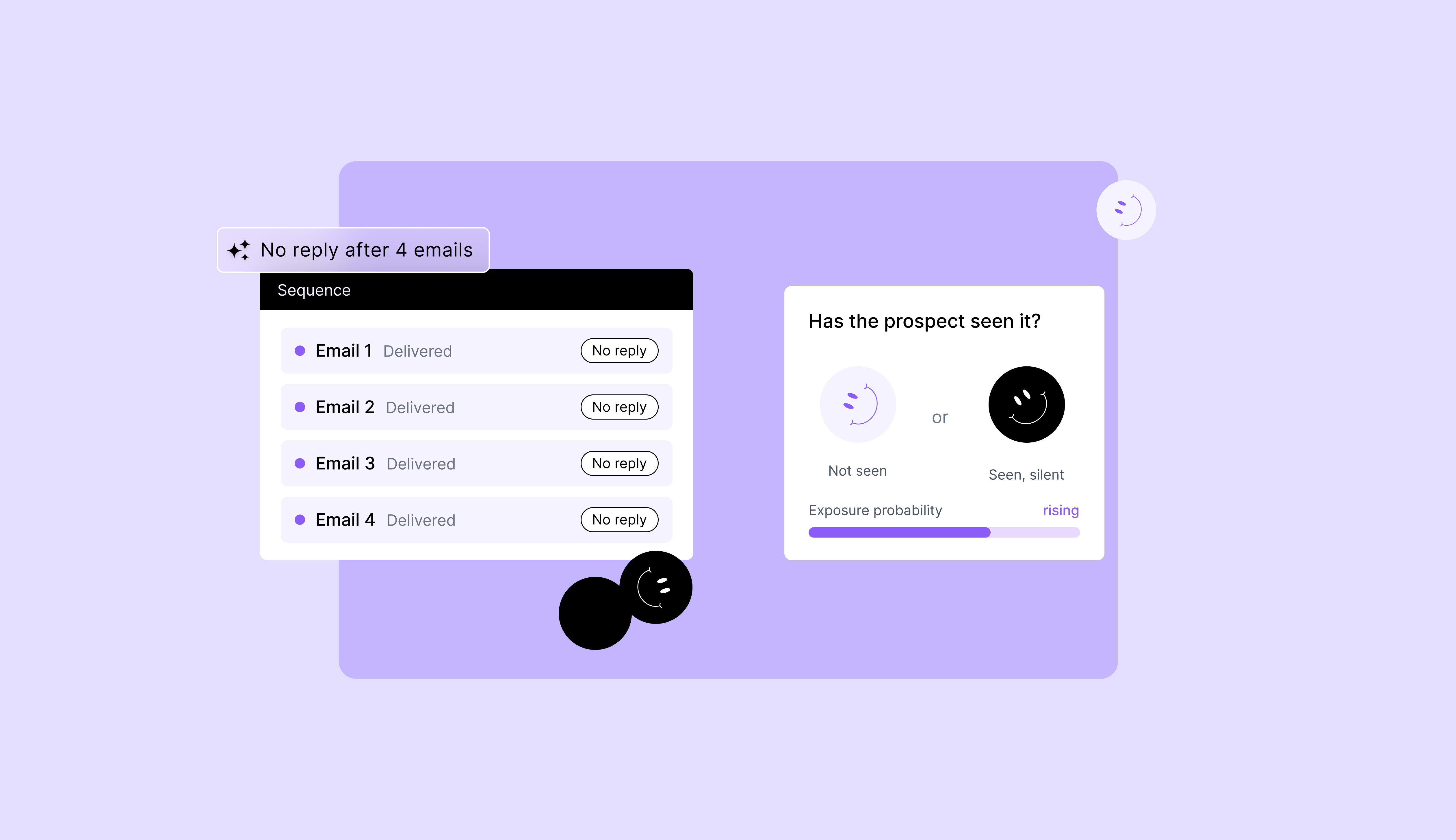
That makes a familiar workflow label - Step 2, Step 3, Step 4 - less informative than it looks. A third email can be the first message a recipient notices, or the third reminder to someone who has already decided not to answer. From the sender side, those states can look identical.
Alta campaign behavior points in the same direction: the share of prospects receiving three or more delivered emails has trended down over time. That does not prove fatigue, but it is consistent with operators shortening sequences as extra touches bring diminishing value and more downside
The data show a jump, then a plateau
Alta reply data point to a regime change rather than steadily accumulating annoyance. On the first email, decisive replies run at roughly three negative replies for every positive one. From Step 2 through Step 5, the ratio jumps into a roughly 3:1 to 5:1 range and then stays surprisingly flat.
If each extra message simply made people progressively more irritated, that ratio should keep worsening. It does not. What changes much more across later touches is whether someone replies at all.
Model the hidden state, not just the step
A simple model starts with two hidden recipient states: unexposed, where earlier messages never really registered; and exposed-but-silent, where at least one message was noticed but produced no decisive reply. Silence does not tell us which state we are in. It only lets us update the probability.
The important variable is πₖ: the probability that the recipient is already exposed but silent before the next email.
The subject line gave us a useful clue
We then looked at a very ordinary sequence choice: whether a later email reused the previous subject. Exact repetition was common - about 56% of later-touch sends. The raw result looked bad: repeated subjects produced roughly three times as many negative replies per send.
But conditional on getting a decisive reply, the sentiment mix was almost unchanged: about 84% negative whether the subject changed or repeated. The difference was activation. Reusing the subject was associated with about 3.1× more decisive replies overall - more positive replies and more negative replies.
A better decision model
That suggests separating two questions. First: will this message activate a human response? Second: if someone responds, how likely is the response to be positive or negative? Sequence state, reachability and subject continuity seem especially relevant to the first. Message construction and prior exposure matter more to the second.
The distinction matters because a strategy that creates more rejection can still create more commercial value if it also produces enough extra positive replies. At the current point estimates, repeating the subject adds roughly one positive reply for every five additional negative replies. Whether that trade is attractive depends on the value of a positive response and the real cost of a negative one - from a polite "not interested" to a spam complaint or deliverability damage.
The shift in perspective
Traditional sequencing treats Step 1, Step 2 and Step 3 as recipient states. They are not. They are sender-side bookkeeping. The more useful state is probabilistic: what has this person probably experienced already, and what is the expected value of another touch?
These findings have already informed how Alta optimizes its outreach sequence model, using evidence about recipient attention and response to improve sequencing decisions.
Sources and notes
- Apple, Mail Privacy Protection & Privacy - remote content can be downloaded in the background regardless of engagement.
- Google, Email sender guidelines - Google does not track opens and cannot verify third-party open-rate accuracy.
- Mailchimp, About Bot Activity and Bot Filtering - automated security and privacy systems can inflate opens and clicks.
- Alta internal analysis - first-message vs later-message reply mix, latent-exposure simulation, OOO/reachability analysis, and subject-repetition vs reply-sentiment findings. Internal ratios are presented without customer-level or campaign-level detail.
Frequently Asked Questions
Privacy features like Apple Mail Privacy Protection can load email content automatically, and security scanners can create clicks that no person made. Opens and clicks no longer tell you whether a person actually saw the email.
Not necessarily. Your sequence tool knows you sent three emails, but not how many the prospect actually noticed. They might be seeing your third email for the first time, or they might have read all three and decided not to answer. From your side, both look exactly the same.
It treats a prospect who hasn’t replied as being in one of two hidden states: they haven’t noticed any message yet, or they’ve seen one and chosen not to reply. The model estimates how likely each state is, instead of assuming the step number tells you where the prospect is.
Not in the way it first looks. In Alta’s data, repeated subjects got about three times as many negative replies per send. But the mix of positive and negative replies was almost the same, about 84% negative either way. Reusing the subject mainly changed how many people replied at all, with about 3.1× more decisive replies.
Separate two questions: will this message get a human response at all, and if it does, how likely is it to be positive? Whether another touch is worth it depends on the value of a positive reply against the real cost of a negative one.